


Climbing Mont Blanc (4,809 m) is far more than a simple hike: it is a serious, demanding alpine undertaking requiring rigorous physical, technical, and logistical preparation. Reaching the summit of the roof of Europe requires professional guidance, gradual acclimatization, and appropriate training.
This comprehensive guide presents, in a structured and precise manner, the access conditions, required skill levels, training programs, recommended periods, and booking procedures to undertake an ascent safely.
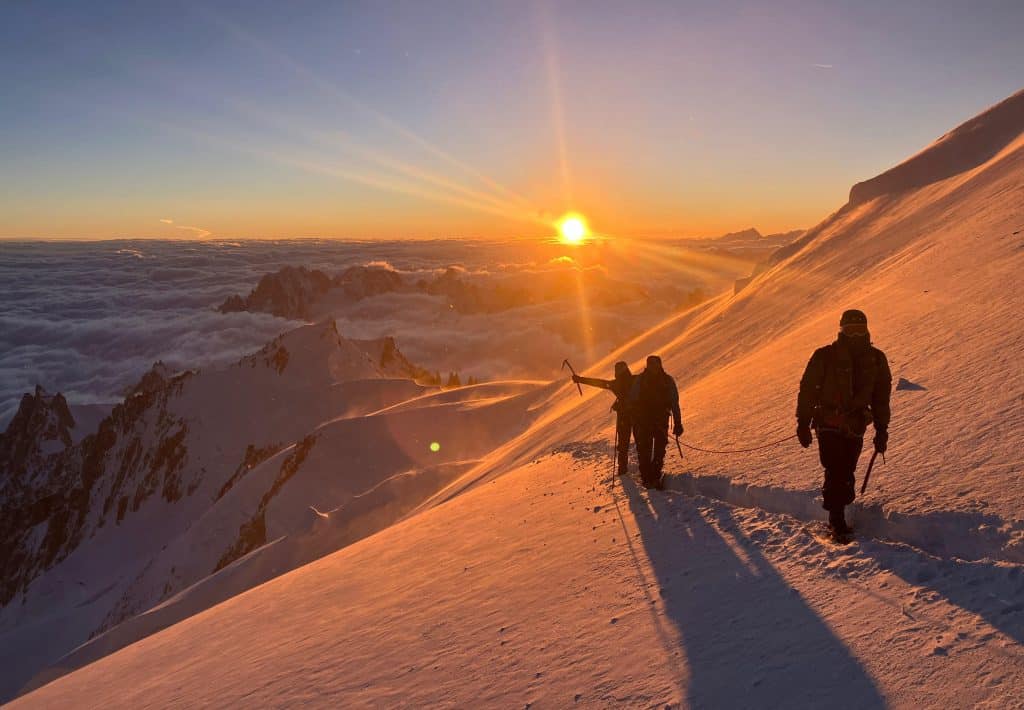
This document is intended for:
- sports people looking to focus on alpine climbing,
- experienced hikers seeking to take the next step,
- experienced alpinists seeking an optimized ascent,
- or anyone planning to undertake serious preparation for Mont Blanc.
Physical requirements: an essential prerequisite
Climbing Mont Blanc requires a high level of physical fitness. It is essential to be able to sustain several hours of continuous effort in a cold, high-altitude environment, while carrying a pack and moving over glacial terrain.
Recommended physical criteria
- regularly practice endurance sports (running, trail running, cycling),
- be capable of hikes with 1,200 to 1,500 m of elevation gain, 300–400 m of elevation gain per hour,
- be able to sustain two consecutive days of intense effort,
- have excellent cardiovascular and respiratory capacity,
- possess a strong mindset to cope with fatigue and variable conditions.
Professional recommendation
If there is any doubt about physical fitness, it is recommended to consider a two-year program:
- Year 1: mountain training + basic techniques
- Year 2: Mont Blanc preparation and ascent
This greatly optimizes both success and safety.


Technical requirements: essential high mountain experience
Recent alpine experience is a mandatory requirement to consider Mont Blanc under safe and favorable conditions.
Required technical skills
- proficiency in roped walking,
- cramponed walking,
- ice axe use (self-arrest and support techniques),
- glacier travel,
- understanding of associated risks (crevasses, falls, exposure).
No novice participant is taken to the summit of Mont Blanc. For those with no experience, a preparatory technical course is the most appropriate route.
Best period for the ascent
The ascent period is directly linked to the opening of high-altitude refuges. It generally spans:
From early June to the end of September
Conditions by month
- June – early July: more winter-like terrain, heavier snow, longer days.
- July – August: more favorable weather, hazards related to rockfall risk
- September: lower temperatures but often stable conditions, with beautiful light.
Available programs
Programs vary depending on initial skill level, alpine experience, and desired objective.
4 day Mont Blanc Preparation Course
For sporty people with no alpine experience
This program serves as a first step toward climbing Mont Blanc and is designed to:
- discover high mountain environments,
- learn basic technical skills (crampons, ice axe, roped travel),
- acclimatize to altitude,
- assess one’s level for a future attempt.
Mont Blanc Ascent Course – 5 or 6 days
For athletes experienced in hiking
Objective: provide optimal guidance, gradual acclimatization, and guaranteed skill progression before heading to the summit. Structured program:
- 3 days of technical training and acclimatization,
- assessment of skill level by the guides,
- 2 or 3 days dedicated to the final ascent.
Mont Blanc in 4 days (program for experienced alpinists)
This format is intended for a self-sufficient, technically strong audience aiming for a fast and efficient ascent. For those who have completed several recent alpine climbs.
Access requirements:
- documented alpine experience within the last 4 years,
- technical skills assessment day,
- prior acclimatization night.
Then:
guided ascent over 3 days.
Booking procedures
Booking is possible:
- through a registration form accompanied by a 40% deposit,
- or directly online via the product page.
Required documents
- copy of your ID (mandatory for the refuges),
- information on your skill level and experience,
- medical form if applicable.
Direct contact: +33 (0)4 50 47 76 55
The professional teams can guide you toward the program best suited to your profile.


Equipment: professional list of required gear
A complete list is provided to ensure safety, efficiency, and comfort during the ascent. It notably includes:
Technical equipment
- rigid alpine boots,
- crampons,
- ice axe,
- harness,
- helmet,
- locking carabiners.
Clothing
- technical base layers,
- fleece or softshell,
- waterproof hardshell jacket,
- lightweight, packable down jacket,
- gloves (two pairs),
- bonnet,
- category 4 sunglasses,
- cache cou type buff.
Other items
- 30–40 L backpack,
- headlamp,
- food and water,
- personal first aid kit.
In collaboration with our partner Haglöfs, expert advice is available to guide equipment selection and ensure gear is suitable for high mountain conditions.
Video resources: preview an ascent before departure
The screening of a course video allows:
- to understand the stages,
- to see the actual conditions,
- to become familiar with the pace of an ascent,
- to better understand the equipment and the refuges.
It is a useful and recommended resource for anyone planning the ascent.
Professional guidance
Guidance by certified mountain guides ensures:
- tailored technical advice,
- risk management (weather, falls, crevasses, fatigue),
- personalized and educational supervision.
personalized and educational supervision.
- your project,
- your physical condition,
- your equipment,
- current conditions in the massif,
- the feasibility of your ascent.
Objective: to provide personalized and professional support.


Mont Blanc Ascent FAQ
What is the success rate of the ascent?
It varies depending on the period, conditions, and preparation, but averages around 60%.
With proper preparation and professional guidance, this rate can exceed 80%.
How long does it take to prepare?
Between 4 months and 1 year, depending on your physical level and alpine experience.
Can the ascent be done without experience?
No.
A preparatory course is essential to acquire fundamental technical skills.
At what age can one attempt Mont Blanc?
From around 17 years old, depending on the program and the guides’ assessment.
What is the most commonly used route?
The Normal Route via the Goûter Route is the most technically accessible, though physically demanding.
Contact & information
For any additional information or to discuss your ascent project, the professional team is available.
+33 (0)4 50 47 76 55
We will guide you in:
- preparation,
- program selection,
- equipment,
- and the complete organization of your ascent.